ANOTHER PAPERLESS CHRISTMAS
By Vanda Brady
“Everyone has his or her own story, so I have no right to say what is best for Filipinos coming to Ireland. But for me, life is not easy here. My advice is, if you are happy in the Philippines, stay where you are and be with your family. But if you really think Ireland is the place for you, remember that the rules and regulations are different and you must abide by them. Be strong, be humble, and don’t cause any trouble. Always show respect to your host country.”
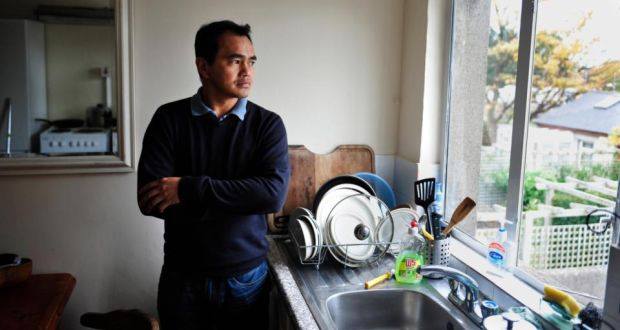
This is Jayson's advice to Filipinos coming to Ireland. I did not anticipate to have quite an emotional journey with him as he recounts his trials and accomplishments in the Emerald Isle. I silently joined him shed a tear or two as he shared his remarkable story. Unfortunately, the battle is not over and he continues to sacrifice and persevere for the good of his family and his fellow undocumented migrants, who, for many years, long for acceptance and respect from the Irish community.
Jayson Montenegro’s Tale of Two Worlds
Jayson was already active in politics back home from 1999 to 2004. He started as a Councilor and then became the Barangay Captain of Pajo, Alfonso in Cavite. (A Barangay Captain is the highest elected official in the smallest administrative divisions of the Philippines.) But after struggling with the challenges of Philippine politics, he decided to take a leave of absence and move to Ireland to join his Uncle Narding who has been residing in the Emerald Isle for 40 years.
In 2004, Jayson and his wife Tess came to Ireland as tourists. They left their three children - now aged 23, 22 and 18 - under the care of his parents and Tess’s sister in their home in Cavite. They entered Ireland with 3-month Tourist Visas which were extended for a month. They have not requested for an extension since.
Tess started working as a nanny while Jayson worked as a maintenance staff of a building company in Dublin. It was a very difficult and dangerous job for Jayson because he had to unclog a large septic tank full of human waste. He recalls crying in the cold and dark chamber with no health & safety gear, treading slowly in waist-high stench and pushing himself to keep on going for the sake of his children. “Paulit-ulit kong sinabi sa sarili ko, “Para sa anak ko ito…Para sa anak ko ito…” (I kept telling myself “I have to do this for my children…. I have to do this for my children….”) He was promised a work permit but unfortunately this was not granted, so he carried on looking for other sources of income. A fellow Filipino who worked as a builder gave him the opportunity to help in a restaurant project but he never paid him for his hard work. It was Christmas season and Jayson had no money to send to his family back home. He painfully decided to charge this to experience, and up to this day he continues to be friendly with his kababayan (fellow Filipino), who sadly has now forgotten the money he owes. That unfortunate incident turned out to be a blessing when he found a job as a care worker for a kind-hearted family in Limerick where he looked after an elderly man named Philip who was suffering from Alzheimer’s. Philip’s daughter Rachael very kindly supported Jayson in getting a qualification in Business Management. She was so generous she even bought him a table that he can use to finish his thesis and other academic requirements while they took turns looking after her father. Philip passed away three years ago, and now another man named Richard is under Jayson’s care.
Since 2010, Jayson and Tess work as part time care workers in Dublin, and are still undocumented. Jayson’s passion for helping undocumented migrants in Ireland started in January 2009 when a friend told him about an upcoming campaign. Jayson kept on attending sessions on migrant cases until Edel McGinley, who was the Community Work Coordinator of the Migrant Rights Centre Ireland (MRCI) at that time, invited him on April 2009 to join a discussion on migrant problems. Jayson and four others (a Brazilian, Sri Lankan, Mongolian and American) attended that first session. Jayson recalls everyone being so scared, including the MRCI who were unsure where to start and could not guarantee their safety, so they all feared incarceration or deportation. But despite the uncertainty, they continued to work out a plan on how to implement their campaign.
It was only in October 17, 2010 when they had the opportunity and the courage to be heard. They were invited to the United Nations Day for the Eradication of Poverty in Dublin where organisers requested a representative from MRCI’s undocumented migrants group to share his or her story. Everyone was reluctant apart from Jayson, who did not only want to help his fellow migrants but was also desperate to go home. He raised his hand, got up on stage and left everything in God’s hands. He faced thousands of people including influential public figures like Christy Burke, the Lord Mayor of Dublin, and other established interest groups. Jayson was so nervous he talked so fast. He got even more uneasy and distracted when he saw the roving Garda (the police force in Ireland) who were securing the event. When he finished, he quickly got off the stage fearful of being restrained. But instead, he was comforted by warm embraces, encouraging handshakes, and pats on the back for his bravery and determination. Here is the testimony that moved many on that commemorative day, and thousands more who heard and read his story on countless occasions after. (Here is the transcript of his testimony.)
Jayson has since been the founding member of Justice for the Undocumented (JFU) campaign group which the MRCI established in line with its regularisation scheme proposal in response to the growing numbers of undocumented persons. After his testimony, the MRCI wanted to get more members involved so Jayson went to a gathering of Filipinos to talk about the campaign, but no one seemed to be interested. Only one or two listened intently but the others looked away and did not even pay attention, which Jayson found very frustrating and demotivating. Little did he know that the element of fear played a big part in their reaction. Undocumented migrants often live in the shadows under tremendous stress and constant fear of deportation. So in reality, the many Filipinos in the party who were in the same situation as Jayson were eager to know about the campaign, but only had the confidence to come forward later on when they were more certain about their safety.
JFU now has 1400 undocumented members and, with allies and supporters, is campaigning for the introduction of a regularisation scheme which would allow over 20,000 undocumented migrants - majority of which are Filipinos (33%) - the chance to come forward and regularise their situation. Jayson made history by speaking on Government Record to the Justice Committee on February 25, 2015 when the MRCI presented its proposal. He shared his experience working for 6 years in maintenance cleaning and painting which he aptly described as "a 3D job - dirty, difficult and dangerous." He also said he would love to see the same political leadership of the kind President Barack Obama has shown in the US. Here is the video and transcript of his testimony. Jayson is now officially in Irish government records. He was awarded the Justice Gala Activism Award on November 14, 2015 for his exemplary work as the spokesperson for undocumented migrants in Ireland.
Jayson continues to fight for the regularisation scheme by attending events, vigils, marches, newspaper and radio interviews, and conferences. And each time, he never fails to fear for his life. He can never forget the time he marched in front of Parliament and his heart stopped when a Garda called him over. He reluctantly obliged thinking he was in trouble, but instead of a barrage of telling-off words and cold cuffs on his wrists, the Garda gave him a big warm hug and greeted him a hefty “Happy Christmas!” Jayson was sobbing (as was I) as he recounts that the genuine love he felt from such an intimidating man of power truly brought him to tears.
Jayson is an irregular worker that has committed an administrative infringement rather than a criminal offence. Some people will say that he is one of the many who disobeyed immigration laws, and that he became undocumented through his own conscious actions or omissions. With the recent attacks in Paris, immigration laws are under scrutiny once again, hindering his chance to go home with confidence, or without the fears of a travelling "law offender." But did he compromise the reputation of Filipino immigrants abroad?
Jayson's decision to move to Ireland was a social remittance that contributed to a "culture of migration" that makes moving almost inevitable because people are no longer satisfied by the economic and social opportunities their homelands offer. Unfortunately, he is become one statistic in reports that point to undocumented migrants’ difficulties and vulnerability in terms of their dignity and human rights. He lives in the shadows and encounters significant problems in accessing basic and essential services, such as health and education.
Sadly, this is Jayson's 11th Christmas away from home. Jayson’s heart breaks whenever his youngest son asks him when he was going home or when he constantly says he doesn’t know his father anymore. “Sino ka, Tay? Hindi na kita kilala.” (Who are you, father? I don’t know you anymore.)” And yet, despite this and missing his father’s funeral, plus countless other birthdays, celebrations and importantmilestones, he has never allowed himself to be swallowed by depression. Instead, he has risen and armored himself with faith and courage to someday put an end to the pains of a so-called illegal worker. He has found his own self-constructed peace as the voice of undocumented migrants, a voice that family and friends can be proud of as they witness his good work, even if they only get to appreciate it in the digital world. He became a better individual as he faced the harsh challenges of integration. His attitude shifted from utter confusion to slowly discovering himself and now finally having an incredible clarity and determination to be heard in a foreign land and beyond. Clearly, he is a perfect portrayal that centuries-old habits of moving abroad for a better life can sometimes be misleading. That happiness and contentment is what you make of it, whether it be in the Philippines or abroad. That whether emigrating was a choice or necessity, a Filipino migrant should build on that happiness and contentment by developing the right attitude, behavior and mind-set, because all of these will be reflected to families and friends back home and the host country.
Jayson's story makes us learn to appreciate what we have, no matter how simple they are, because somewhere out there, not only in Ireland, we have kababayans (fellow countrymen) who are not having it easy. Like Jayson, thousands of undocumented migrants are longing for one legal document that would put an end to their woes. One piece of paper that would hopefully bring them home next Christmas.
Justice for the Undocumented (JFU) Campaign: Proposal for the Introduction of a Regularisation Scheme
Migrant Rights Centre Ireland (MRCI)’s 2010 proposal for the introduction of an earned regularisation scheme draws on international best practice and is based on informed, evidence-based policy. This earned regularisation proposal is centred on an agreed set of transparent criteria, including a provision for the length of time resident in Ireland, a requirement to enter into a probationary period, the operation of a criminal bar, and an administration fee to offset the cost of implementation. MRCI believes regulation makes sense for five reasons:
1) It is good for the economy because if regularised, undocumented migrants could contribute over €18.3 million per year in direct taxation alone;
2) It is good for governance and government because the regularisation programme will enable the government to quantify its undocumented population and therefore improve the overall public security, law enforcement, and compliance and enhances governance of the immigration system;
3) It will keep Ireland in step with international practice where many of its EU partners recognise regularization policies as part of managing migration;
4) It is good for communities and social cohesion for migrant workers who have put down roots and call Ireland home; and
5) It lives up to Ireland’s humanitarian commitments as it provides a response for undocumented individuals, families and children to escape the constant fear, stress, poverty and isolation associated with living undocumented.
Department of Justice officials are currently considering the proposal. They have previously said the Republic is a country which welcomes non-nationals, with more than 80,000 people naturalised over the past four years. But they have pointed out that the State is entitled to expect that people coming to the Republic will obey our immigration laws, and that most people become undocumented through their own conscious actions or omissions.
MRCI said undocumented men, women and children in Ireland had the same struggles, hopes and dreams as undocumented Irish in the United States. The MRCI’s research indicates that undocumented migrants encounter significant problems in accessing basic and essential services, such as health and education. They also remain unable to leave the country to visit extended families. The centre says it is particularly concerned about the vulnerable situation of the estimated 5,000 children of undocumented migrants, many of whom have gone to school here yet face an uncertain future.
To date, over 40 organisations across civil society and the business sector, along with county and city councils (see photo below), have endorsed JFU's regularisation proposal. Also, a majority of the Irish public is in favour of allowing undocumented migrants the right to live and work here legally, according to a poll commissioned by the Migrant Rights Centre Ireland (MRCI). The Red C poll, carried out in June 2015 among a representative sample of just over 1,000 people, found that 69 per cent were in favour of providing undocumented people a route back into the system.
